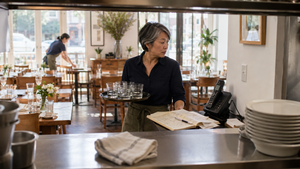
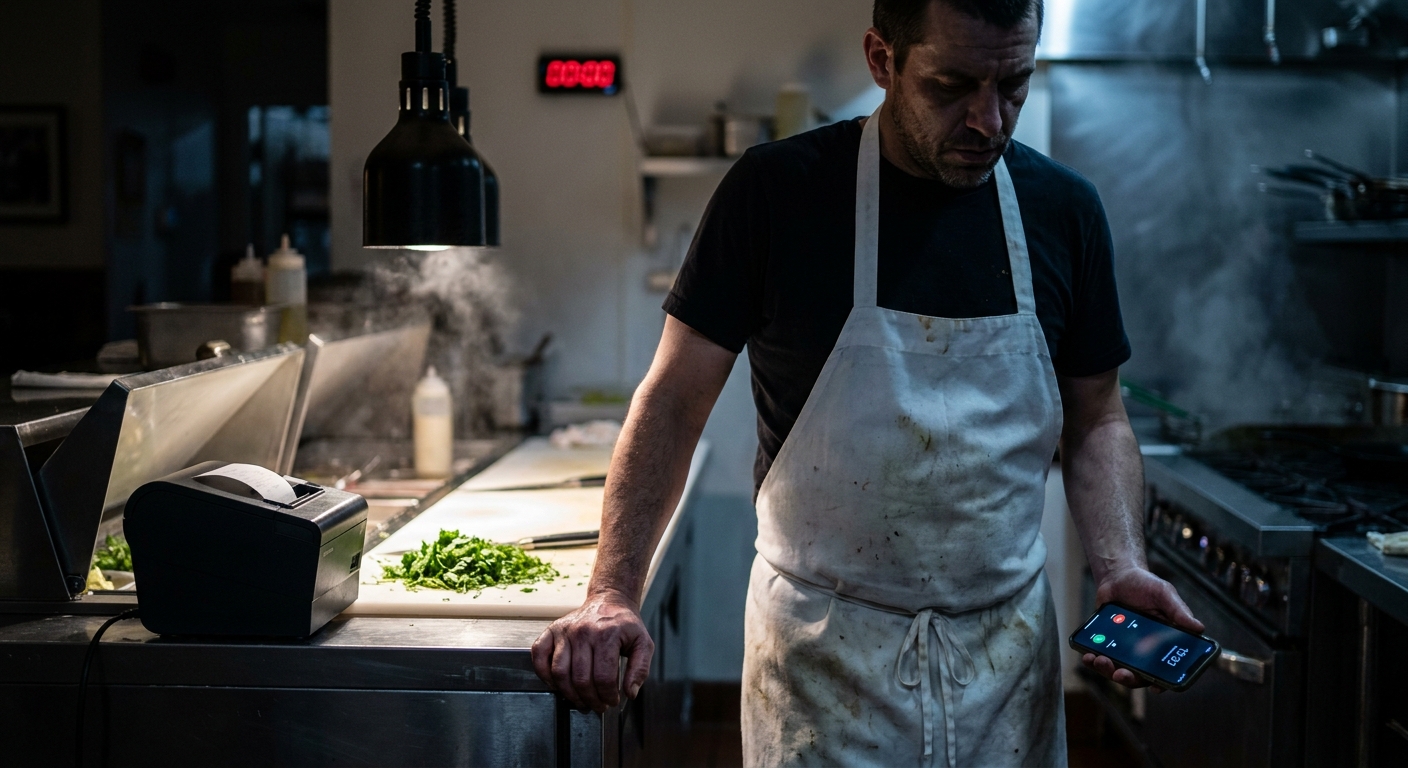
It’s 7:15 PM on a Friday. You’re in the weeds. Expo is backed up. The bar is three deep. Your host is seating a four-top with a wobbly toddler seat, and the phone rings.
She looks at it. You look at her. The phone keeps ringing.
She doesn’t pick it up. There is no time.
You tell yourself it was probably a delivery order or someone asking about hours. But it wasn’t. It was a party of four looking for a 8:30 table. They called three restaurants. You were the second. Nobody answered at the first one either. So they booked the third restaurant that picked up.
You lost that party. And you’ll never know they called.
That happens 33% of the time during peak hours. According to Maple’s study of over one million restaurant calls between 2023 and 2025, that is exactly how many calls go unanswered during dinner service. A full third of potential guests who try to reach you are met with silence.
This piece is not about phone anxiety or hiring more staff. It is about the math that is quietly bleeding your restaurant dry.
The Math That Hurts
Let’s be direct. A single missed call from a party of four carries real revenue. Assume an average check of $65 per person (the national average for independent casual dining in 2025). That is a $260 table. Even conservatively, if your host misses three calls per dinner shift, that is $780 in potential revenue sitting on the table.
But we need to be honest about what a call converts to. Not every call turns into a seated party. Data from restaurant phone systems suggests a conversion rate of roughly 60–70% for inbound reservation calls. Using 65% as a realistic midpoint, a missed call from a four-top represents about $169 in expected revenue. That is not hypothetical. That is the statistical likelihood of what walks out the door each time the phone rings unanswered.
Now multiply that by a missed-call rate of 33% across a typical Friday and Saturday dinner service, with twenty calls coming in per peak period. That is six to seven missed parties per night.
Maple’s study of 1M+ calls calculated the monthly revenue at risk per venue at up to $4,200. That is over $50,000 a year in revenue that walks out silently because the phone rang at the wrong moment.
And that number does not include the repeat visits you never got, the wine bottle they would have ordered, the birthday celebration that would have become a yearly tradition, or the regulars they might have become.
Your Guests Have Zero Patience
A Harris Poll conducted in 2025 found that 69% of guests are likely to give up on a restaurant if their call goes unanswered. Not “maybe call back later.” They give up. They move down the street. They open DoorDash. They pick the spot that answered.
This is not a loyalty problem. This is an availability problem. Your regulars will forgive a busy signal once. A party of tourists who are trying to decide between your spot and the one next door will not.
The same Harris Poll data showed that 71% of guests assume a restaurant is closed or too busy to accommodate them if nobody picks up. Perception becomes reality in the time it takes for a phone to ring four times.
And here is the part that stings. Only 17% of guests who visited a restaurant in 2023 returned in 2024, according to DataDelivers’ 2025 analysis of 180 million transactions across 2,000+ locations. You are hemorrhaging both new and returning guests. The missed call is not a small leak. It is a structural hole in your boat.
How to Diagnose This in Your Restaurant Tonight
Before you buy a single tool or change a single policy, you need to know how bad it actually is. Here are three things you can do tonight, for free.
1. Count the rings. Stand near the host stand during peak service tonight. Do not answer the phone. Just count how many times it rings and where it dies. Do this for one hour. Multiply by 2.5 for a full dinner shift. That is your baseline call loss.
2. Review your missed call log. If your phone system keeps a log, look at the pattern for the last month. How many calls came in between 6:00 PM and 9:00 PM on Fridays and Saturdays that lasted fewer than 15 seconds? Those are hangups. That is lost business.
3. Ask your host. Your host knows exactly how many calls they ignore. Ask them. Not in an accusatory way. Say: “During the rush, how many calls do you think you have to let go per shift?” They will tell you. And it will be higher than you think.
What You Can Do About It
You have options. They range from free and manual to fully automated. The right choice depends on your volume, your staffing, and your tolerance for friction.
Option 1: Assign a designated phone person (free, requires staff). During peak periods, assign one FOH staff member to handle calls and low-priority tasks. This works if you have the bodies. Most independent operators do not. If you are running a two-person front-of-house team on a Saturday, this is not realistic.
Option 2: Change your phone greeting and voicemail (free, immediate). Record a clear voicemail that says: “We are serving dinner and cannot answer the phone right now. Please leave your name, party size, and a callback number, and we will call you back within 30 minutes.” Then actually call them back. This works passably for low-volume nights and fails on a packed Saturday.
Option 3: Use a call-answering service (moderate cost, human). Services like Ruby Receptionists or similar provide live operators who answer your line. Expect to pay $300–$600/month for peak-hour coverage. They can handle simple reservations but lack specific knowledge about your menu, your floor plan, and your preferences for table allocation.
Option 4: Automate inbound calls and messages with a system designed for restaurants. This is where a tool like ToBeOut AI Hostess fits. It answers every inbound call and message, 24/7. It confirms reservations, captures guest names, party sizes, contact info, and preferences. It works during the Friday dinner rush, Thanksgiving rush, and Sunday brunch chaos. No staff time required. No missed calls. No voicemail purgatory. It puts the booking directly into your calendar and adds the guest to your database.
The key word there is “database.” Because the call is not the only thing you lose. You lose the data. That guest’s name, their birthday, their anniversary, their preference for a booth near the window, their last visit date. That data is the difference between a one-off diner and a regular who comes back four times more often, as DataDelivers found with personalized outreach.
The Opportunity Cost of Silence
Let’s step back. The phone ringing during service is not an interruption. It is a guest walking through an invisible door. Every unanswered ring is a guest who turns around and walks to a different door.
We know from the same DataDelivers report that 92% of first-time guests who received no personalized communication after their first visit never came back. That first interaction matters. And if you never even knew they called, you cannot follow up. You cannot welcome them back. You cannot build the relationship that turned them into one of “your regulars.”
The numbers are not abstract. They are happening right now in your restaurant. In the time it took you to read this article, your restaurant probably missed a call. And that call just booked at the place down the street.
You built this place with your hands and your heart. The least you deserve is the chance to greet every guest who wants to walk through your door. Whether they call at 2:00 PM on a Tuesday or 8:15 PM on a Saturday.
Stop letting the phone ring into silence. Your guests are waiting.
Sources
- Harris Poll 2025 — State of Beverages 2025 (cited for guest behavior data on unanswered calls). Available at: https://theharrispoll.com/briefs/state-of-beverages-2025
- Maple, “The State of Restaurant Phone Communication: Insights from 1 Million Calls” (2023–2025). Available at: https://www.maple.inc/blog/the-state-of-restaurant-phone-communication-insights-from-1-million-calls
- DataDelivers 2025 Guest Engagement Report (based on 180M+ transactions across 2,000+ locations). Findings on guest return rates, personalization impact, and first-time guest retention.